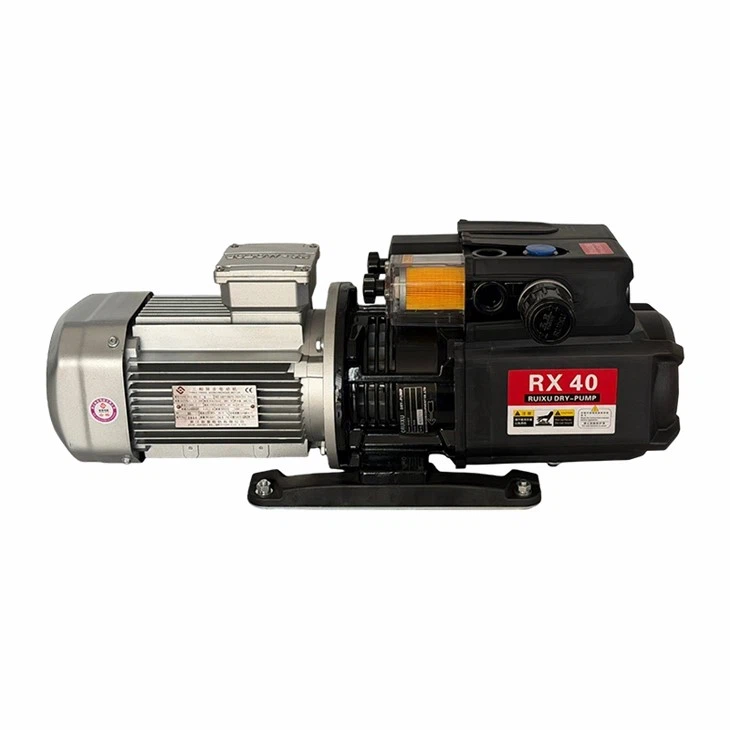
Dry vacuum pumps primarily take the following forms:
Twin-Lobe Type
The design of the twin-lobe type is very similar to that of the Roots pump, which is currently the most popular and widely utilized type. In fact, some of the earliest concepts for dry pump designs involved essentially stacking multiple Roots pumps together. This multi-stage design results in a rather complex gas flow path, and each stage requires a substantial flow of nitrogen gas to serve as both a diluent and a barrier. Furthermore, to achieve a high degree of vacuum, extremely strict tolerances regarding the clearances between stages are required. Of course, because this design increases the internal compression ratio, its power consumption is relatively low.
Tri-Lobe Type
The operating principle of the tri-lobe type is identical to that of the twin-lobe type; the only difference is that, during a single rotation, the gas is divided into three discrete packets-rather than two, as is the case with the twin-lobe design. Consequently, these two designs share the same set of advantages and disadvantages. To further reduce power consumption, some manufacturers opt to employ two DC motors in the drive mechanism; however, this approach also results in reduced torque and a diminished capacity for restarting the pump. As with the twin-lobe design, each stage of the tri-lobe design requires a substantial flow of nitrogen gas to perform dilution and isolation functions.
Hybrid Type (Roots + Claw)
The Hybrid (Roots + Claw) design utilizes a Roots stage to enhance pumping efficiency at lower pressure levels, while employing a Claw stage to boost efficiency at higher pressure levels. Its fundamental operating principles and gas flow path are identical to those of the aforementioned lobe-type designs. Some manufacturers, however, choose to replace the final stage with a "star-type" design; this configuration allows the gas to be divided into five discrete packets per rotation-much in the same way that the tri-lobe design divides it into three. Similarly, in many complex process applications, each stage of the hybrid design requires a substantial flow of nitrogen gas to serve as a diluent and a barrier.
External Compression Screw Type
The external compression screw-type design employs a pair of equidistant screws. This configuration minimizes internal compression while simultaneously creating the shortest and simplest possible gas flow path. Consequently, the residence time of the gas within the pump chamber is kept to an absolute minimum. Although this design incurs relatively higher power consumption due to its reduced internal compression ratio, it demonstrates exceptional stability and reliability in a wide range of complex semiconductor manufacturing processes. This single-stage design imposes minimal and simple requirements regarding nitrogen consumption, thereby ensuring excellent interchangeability across various processes. In many clean processes, the use of nitrogen can even be entirely dispensed with.
Internally Compressing Screw Pumps
Aside from utilizing a pair of non-isoparametric screws, the fundamental operating principles of the internally compressing screw pump design are highly similar to those of the externally compressing screw pump design. The continuous reduction in the volume between the screws generates internal compression. By facilitating this internal compression, this design reduces power consumption to a level comparable to that of multi-stage pumps. However, in many processes-much like with multi-stage pumps-this internal compression is highly prone to inducing physicochemical changes in the gas within the pump body, potentially leading to solidification or liquefaction.