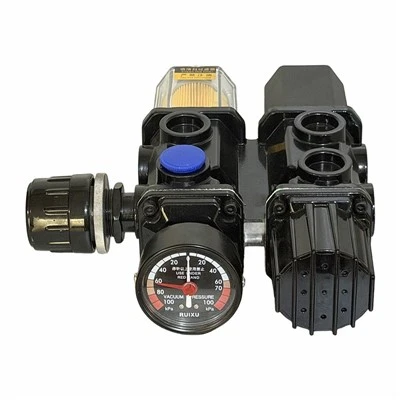
The Operating Principle of Vacuum Pumps
The working principle of a vacuum pump is akin to that of an "air pump"; its primary objective is to extract air from a container, thereby creating a vacuum environment. Specifically, once the motor is activated, it drives a rotor located within the pump body to spin at high velocity. The blades mounted on the rotor fit snugly against the inner walls of the pump chamber; as the rotor spins, these blades "capture" air entering through the intake port. Subsequently, as the rotor continues to rotate, this captured air is compressed and channeled toward the exhaust port, where it is ultimately expelled from the pump. This cycle repeats continuously, progressively reducing the volume of air within the container and thereby increasing the degree of vacuum achieved. In essence, a vacuum pump utilizes the power of an electric motor to enable the rotor to continuously "capture" and "expel" air, thereby accomplishing the task of creating a vacuum.
Vacuum Pump Pads: Small Accessories with a Big Impact
When discussing vacuum pumps, one cannot overlook a critical accessory: the vacuum pump pad. Although it may appear to be merely a small cushion, its functional significance should not be underestimated. During operation, a vacuum pump inevitably generates a certain degree of vibration and noise; the pump pad acts like a pair of "soft-soled shoes" for the pump, effectively dampening and preventing the transmission of these vibrations and noises. Furthermore-and perhaps more importantly-the pump pad serves a vital sealing function, preventing air from leaking into the system through the minute gaps between the pump body and its mounting surface, thereby safeguarding the integrity of the vacuum. A properly selected pump pad ensures that the vacuum pump operates more stably and quietly, while also contributing to an extended service life for the pump.
How to Choose the Right Vacuum Pump Pad?
Selecting a vacuum pump pad is not a matter of simply grabbing any available cushion; rather, the choice must be carefully tailored to the specific pump model and its operating conditions. For instance, if the pump operates at elevated temperatures, one must select a heat-resistant pad; failure to do so risks the pad deforming, thereby compromising both its sealing and vibration-damping capabilities. Similarly, if the pump is situated in a humid environment, a pad with superior water-resistance is essential to prevent moisture absorption, which could otherwise lead to mold growth or material degradation. Additionally, the material composition of the pump pad is a critical factor; common options include rubber and silicone. Different materials exhibit varying characteristics regarding elasticity, wear resistance, and sealing efficacy; therefore, the selection should be guided by the specific requirements of the application. By choosing the appropriate pump pad, one can significantly enhance both the operational efficiency and overall stability of the vacuum pump.